We helped 75+ brands generate $1.56M+ in revenue. Average ROI: 240% in Year 1
Every year, a new advertising platform emerges claiming to be the next big thing for small business marketing. And every year, businesses waste money testing platforms that are completely wrong for their customer base, their offer, or their budget.
The truth is, there is no universally best platform. There is the best platform for your specific business, your specific customer, and your specific goal. A local plumber and an ecommerce clothing brand selling to 22-year-olds should not be advertising on the same platforms — and running the same campaigns on both would be a waste for at least one of them.
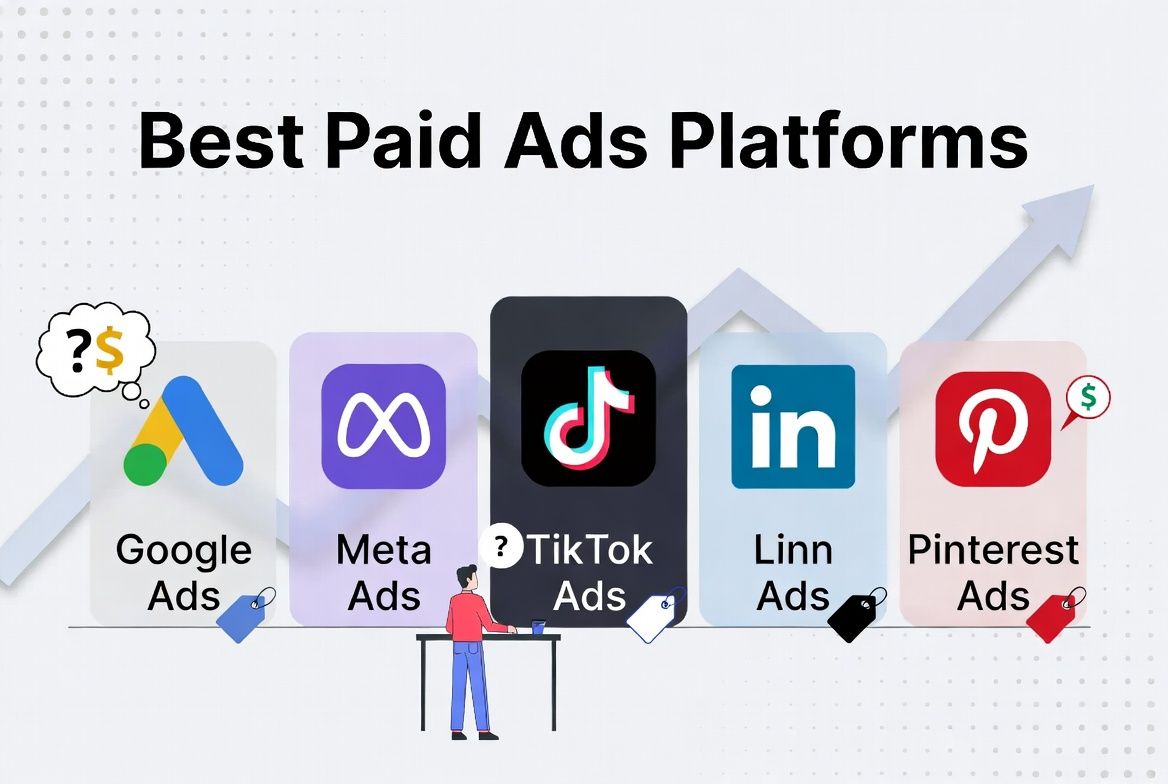
This guide cuts through the noise. Here is an honest comparison of every major paid advertising platform in 2025 — what each one does well, what it costs, who it is right for, and a clear decision matrix to match your business to the right channel.
At AheadTech360, we run campaigns across all the platforms in this guide. The question we ask every new client before recommending a platform is always the same: 'Where does your customer spend their time online, and what are they doing when they might encounter your business?' The answer to that question — not the platform's popularity or our personal preference — determines where your budget goes.
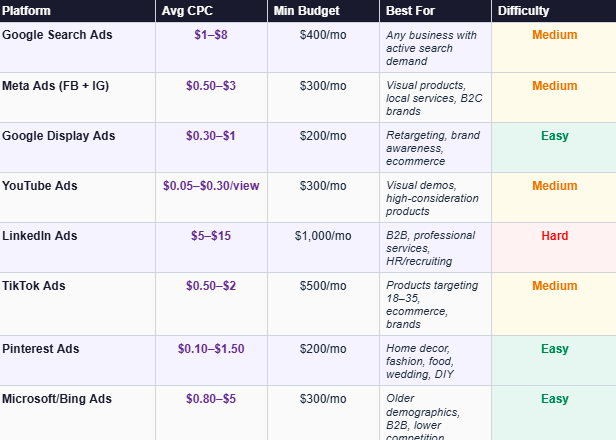
CPC = cost per click. 'Min Budget' = minimum monthly ad spend to generate meaningful data. 'Difficulty' = how complex the platform is to manage effectively.
Google Search Ads appear at the top of search results when someone actively searches for what you offer. This is demand capture — you are not creating the desire, you are responding to existing demand. Because the searcher is actively looking, Google Ads consistently generates the highest conversion rates of any paid channel.
Best for — Local service businesses (plumbers, dentists, lawyers, cleaners, contractors), professional services, any business whose customers search Google when they need help. If someone searches 'HVAC repair near me' and you show up — they call.
Not ideal for — Businesses with no existing search demand (new product categories, impulse purchases), very broad brand awareness goals, businesses with average order values under $50 (the CPC math rarely works).
Meta Ads reaches 3+ billion people across Facebook and Instagram with the most sophisticated demographic, interest, and behaviour targeting available. Unlike Google, you are interrupting people who are not actively searching — so your ad must create desire or stop the scroll with relevance.
Best for — Ecommerce brands, local service businesses (for planned services, not emergencies), restaurants, real estate, health and wellness, any business with a visual product or compelling before/after story.
Not ideal for — High-urgency services where customers search rather than browse (emergency repairs, legal crisis), very technical B2B products requiring long consideration, businesses without any visual assets.
YouTube is the second largest search engine in the world. YouTube ads appear before or during videos and charge per view (you only pay if someone watches at least 30 seconds or interacts with your ad). For businesses with a visual story to tell — before/after transformations, product demonstrations, customer testimonials — YouTube offers enormous reach at a very low cost per impression.
Best for — Home improvement, fitness, beauty, cooking, outdoor services — any business where showing the work in video format builds more trust than a static image ever could. Also strong for retargeting website visitors with video content.
Not ideal for — Businesses without video assets or production capability. The platform rewards quality creative — low-quality phone footage without a clear message will underperform significantly.
LinkedIn is the only platform where you can target by job title, company size, industry, seniority level, and specific companies by name. For B2B businesses targeting decision-makers, this targeting precision is unmatched. The trade-off: LinkedIn CPCs are 5–15x higher than other platforms, making it cost-prohibitive for many small businesses.
Best for — B2B software and services, recruiting and HR, professional training, consulting services targeting specific industries, businesses selling to C-suite or VP-level executives at specific company types.
Not ideal for — B2C businesses, local service businesses, or any business where the $1,000+/month minimum effective budget cannot be justified by the customer lifetime value.
TikTok's ad platform has matured significantly and now offers sophisticated targeting, lead generation forms, and conversion tracking comparable to Meta. The audience skews heavily toward 18–34 year-olds, and the content format is exclusively short-form video. The CPCs are still relatively low compared to Meta because the platform is less saturated with advertisers.
Best for — Ecommerce brands, fashion, beauty, food, entertainment, any brand targeting Gen Z and millennials with content they would actually want to watch. TikTok rewards authentic, entertaining content — traditional product ads underperform significantly.
Not ideal for — Local service businesses targeting 35+ demographics, B2B, or any business without the capability to produce short-form video content consistently.
Find your business type below for a clear starting recommendation:
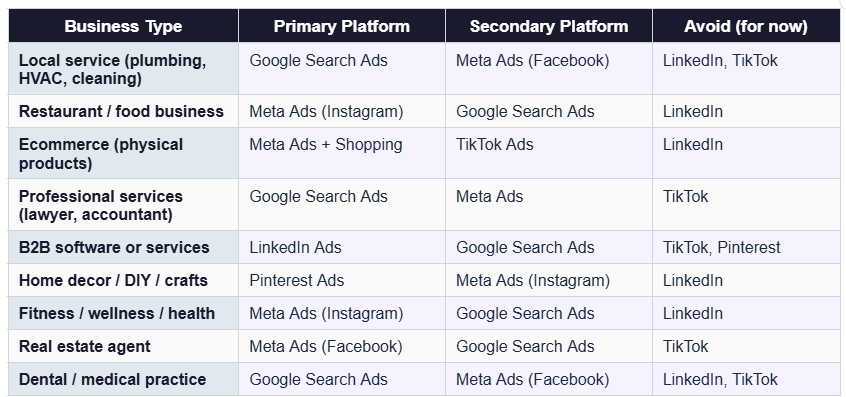
The biggest paid advertising mistake small businesses make is trying to be everywhere at once. Running a $1,000/month budget across Google, Meta, LinkedIn, and TikTok simultaneously means $250 per platform — not enough to generate meaningful data on any of them, and not enough to exit the learning phase on most. Pick one primary platform that best matches your customer demographic and spend at least 80% of your budget there. Add a second platform only after the first is generating profitable results consistently.
For most local service businesses with a $400–$800/month budget: start with Google Search Ads exclusively. Target your highest-value service keywords with exact and phrase match. Get the campaign profitable before spending a dollar elsewhere. Once Google Ads is generating a consistent, positive ROI, add Meta Ads retargeting (20–25% of budget) to capture website visitors who did not convert. This two-platform approach — search for acquisition, social for retargeting — typically produces the best blended cost per lead for most local service businesses.
The best paid advertising platform is not the one with the most users, the cheapest clicks, or the most features. It is the one where your specific customer spends time, at the moment they are most likely to be interested in what you offer, at a cost that makes the economics of customer acquisition work for your business.
Start with one platform. Spend enough to generate real data. Optimize until it is profitable. Then add a second platform as a complementary channel — not as a replacement for doing the first one well.
Platform choice is the first decision. Execution, optimization, and patience are what convert that choice into results.