We helped 75+ brands generate $1.56M+ in revenue. Average ROI: 240% in Year 1
Every week, another marketing expert tells you that email is dead. Social media is the future. Short-form video is everything. Build your TikTok presence. Go all in on Instagram.
And every year, email marketing quietly delivers a higher return on investment than every single one of those channels.
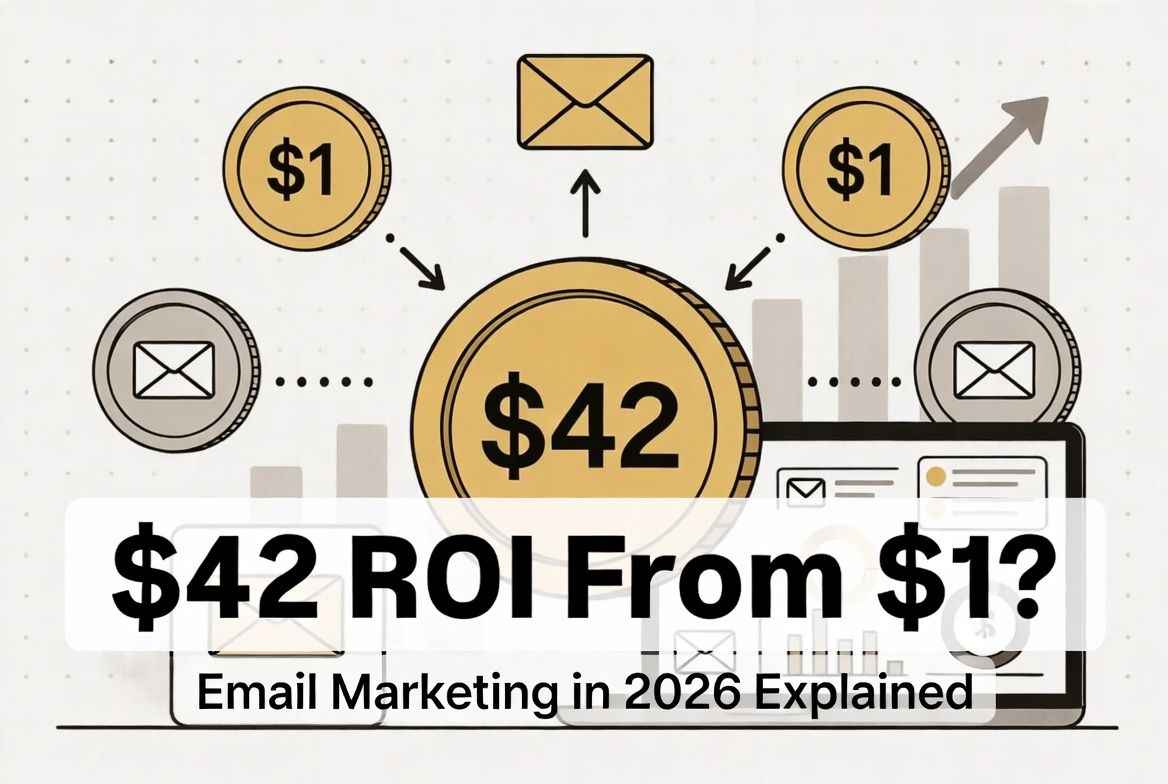
Email marketing has an average ROI of $42 for every $1 spent. Not a typo. Not a cherry-picked outlier. A consistent, industry-wide average across small businesses, ecommerce, B2B, and professional services.
So why do so many small business owners either avoid it entirely, try it once and give up, or never get past collecting a handful of email addresses? Usually because they don't fully understand what email marketing actually is, what results are realistic, and how to set it up in a way that runs on autopilot rather than consuming hours every week.
This guide answers the real question: is email marketing worth it for your specific business — and if so, what does a realistic return actually look like?
Average email marketing ROI — the highest of any digital marketing channel in 2026
Email marketing is not about sending mass blasts to a purchased list of strangers. It's not about flooding people's inboxes with weekly newsletters nobody asked for. That version of email marketing is dead — and it deserves to be.
Modern email marketing for small businesses is three things: communicating with people who have explicitly asked to hear from you, delivering valuable content or offers that make them want to stay subscribed, and using automation to make this process largely hands-off after the initial setup.
Done right, your email list is the most valuable marketing asset your business owns — because unlike your Instagram followers or your Facebook fans, your email list cannot be taken away by an algorithm change. You own it completely. You can reach every person on it for almost no cost. And the people on it have already said they're interested in what you offer.
At AheadTech360, we tell every client the same thing: the best time to start building your email list was the day you opened your business. The second best time is today. Every day you delay is another day of lost customer data — people who visited your website, walked into your store, or bought from you once and never heard from you again. A simple email capture form and a basic welcome sequence captures that value before it disappears.
Here is how email marketing compares to the other main digital marketing channels available to a small business, based on industry average data for 2026:
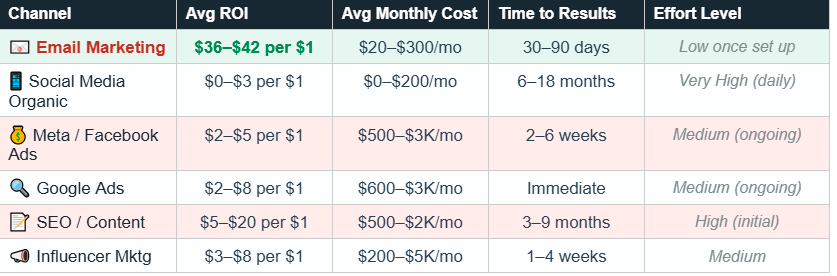
The email marketing ROI numbers are not a one-time spike — they represent the long-term compounding value of a list that grows over time, where each new subscriber adds incremental revenue for months or years. A customer who buys once and remains on your email list can be converted to a repeat customer, referred, upsold, or reactivated — all for the cost of sending an email.
One number that shocks most small business owners we work with: the average email click-through rate (2–5%) is 6x higher than the average Facebook organic post reach. Your email list of 500 people will generate more measurable engagement than a Facebook page with 2,000 followers — because email lands in a personal inbox, not in an algorithmic feed that may or may not show it.
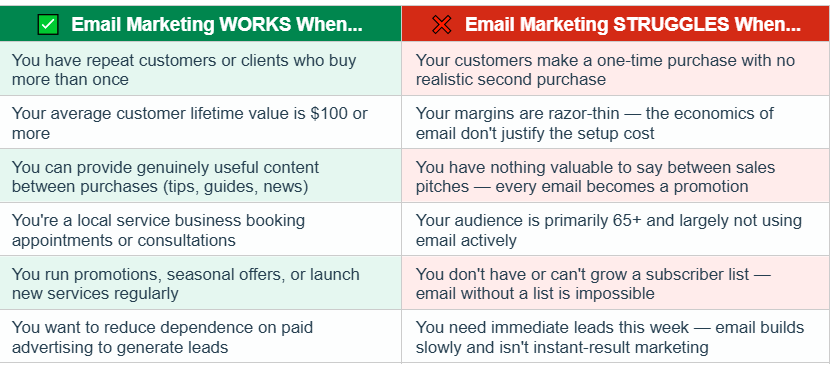
Email marketing is not universally effective for every business situation. Like any channel, its performance depends on the fit between the channel's strengths and your business model.
The single biggest mistake small businesses make with email marketing is starting with the tool instead of the strategy. They sign up for Mailchimp, import whatever emails they have, send one promotional email, get a 15% open rate, and conclude 'email marketing doesn't work.' Email marketing works when you have a plan: a reason for people to subscribe, a welcome sequence that builds trust, and consistent valuable communication that makes people want to stay on your list. Without that foundation, the tool is irrelevant.
Email marketing has one of the lowest cost structures of any digital marketing channel. Here's a realistic breakdown:
Email platform subscription — $0–$80/month for most small businesses. Mailchimp, MailerLite, and Brevo all offer free plans for lists under 500–1,000 subscribers. Paid plans with automation features typically cost $20–$60/month for lists under 5,000. Compare this to $500–$3,000/month for paid advertising.
Your time (DIY) — After initial setup (4–10 hours), a well-automated email program requires 1–3 hours per week to write and schedule campaigns. With good automation sequences in place, even that drops significantly.
Professional setup (agency) — A professionally built email marketing system — platform setup, welcome sequence, segmentation, and 3–4 automated campaign sequences — typically costs $800–$3,000 as a one-time setup fee, plus $200–$600/month for ongoing campaign management.
A local cleaning business with 400 email subscribers sends one promotional offer per month (1 hour of work). Average open rate: 28%. Average clicks: 40. Average bookings from email per month: 6. Average job value: $180. Monthly email revenue: $1,080. Monthly email platform cost: $20. Net return: $1,060 from 1 hour of work. This is not a best-case scenario — it's what a basic, consistently executed email program looks like for a local service business after 6 months of list growth.
Email marketing is worth it for the vast majority of small businesses — and particularly for service businesses, ecommerce brands, and any business where repeat customers are the foundation of sustainable revenue.
It's not worth it if you're looking for instant results this week, if your business truly has a one-and-done customer model with no repeat purchase opportunity, or if you're not prepared to invest in growing a list properly rather than buying contacts.
For everyone else: no other marketing channel lets you reach your warmest audience, at almost zero cost, with a message they asked to receive, that generates a 42x return on average. That's worth building.