We helped 75+ brands generate $1.56M+ in revenue. Average ROI: 240% in Year 1
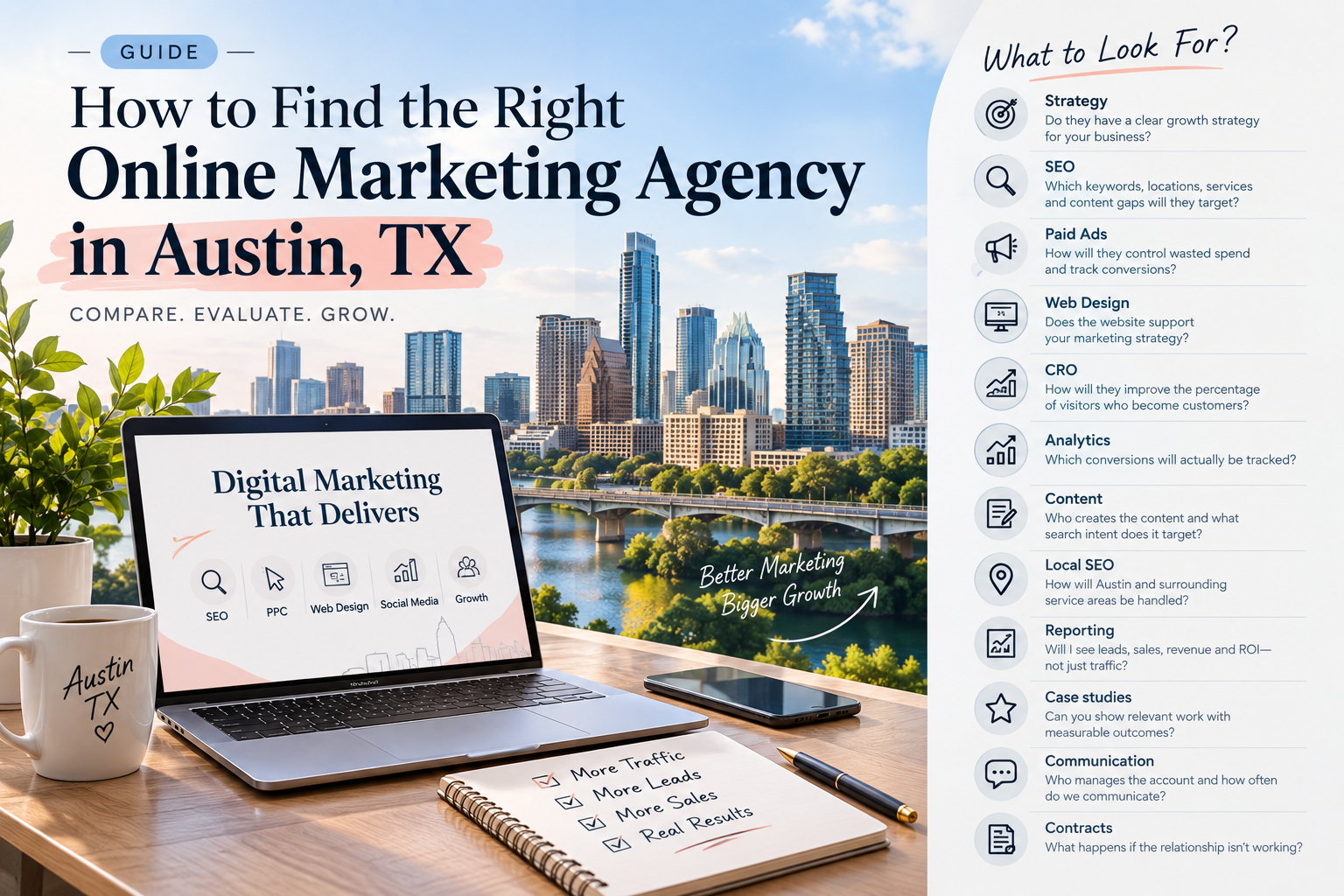
Finding the right online marketing agency in Austin is not about choosing the agency with the longest service list or the most impressive-looking proposal. You need a partner that understands your market, can connect marketing channels to your customer journey, and can show what its work is actually supposed to produce.
If you're searching for Austin marketing agencies, you're entering a competitive market where businesses need to compete across Google Search, Google Maps, paid ads, social platforms, websites, and increasingly AI-generated answers.
Which Austin agency should I hire?
Which agency can build the marketing system my business actually needs?
An online marketing agency helps businesses attract potential customers through digital channels such as SEO, paid search, social media, websites, content, email, and conversion optimization. The exact services vary by agency, but the useful distinction is whether those channels are managed as disconnected activities or as one customer journey.
For a local Austin business, that journey might look like:
Google Search → Website → Landing Page → Form/Call → Sales Team → Customer
For an ecommerce company:
Google/Meta → Product Page → Cart → Checkout → Purchase → Email Retention
For a B2B company:
Search/LinkedIn → Landing Page → Lead Magnet → Form → Sales Call → Client
The agency you choose should understand what happens at every step.
One of the biggest problems with digital marketing is that businesses often buy individual activities instead of a complete growth system.
SEO may generate traffic.
Google Ads may generate clicks.
A website may look professional.
Social media may generate engagement.
But if those pieces aren't connected to a conversion path, the business can still struggle to generate revenue.
positions its approach around connecting marketing activity to measurable business outcomes rather than treating traffic as the final goal. Its published results include SEO, paid advertising, CRO, email, ecommerce, and web development work.
When comparing Austin marketing agencies, evaluate strategy, relevant experience, services, reporting, conversion tracking, communication, pricing, and documented results rather than choosing based only on a portfolio or sales presentation. A good agency should be able to explain what it will do, why it matters, and how the work will be measured.
Here is a practical framework:
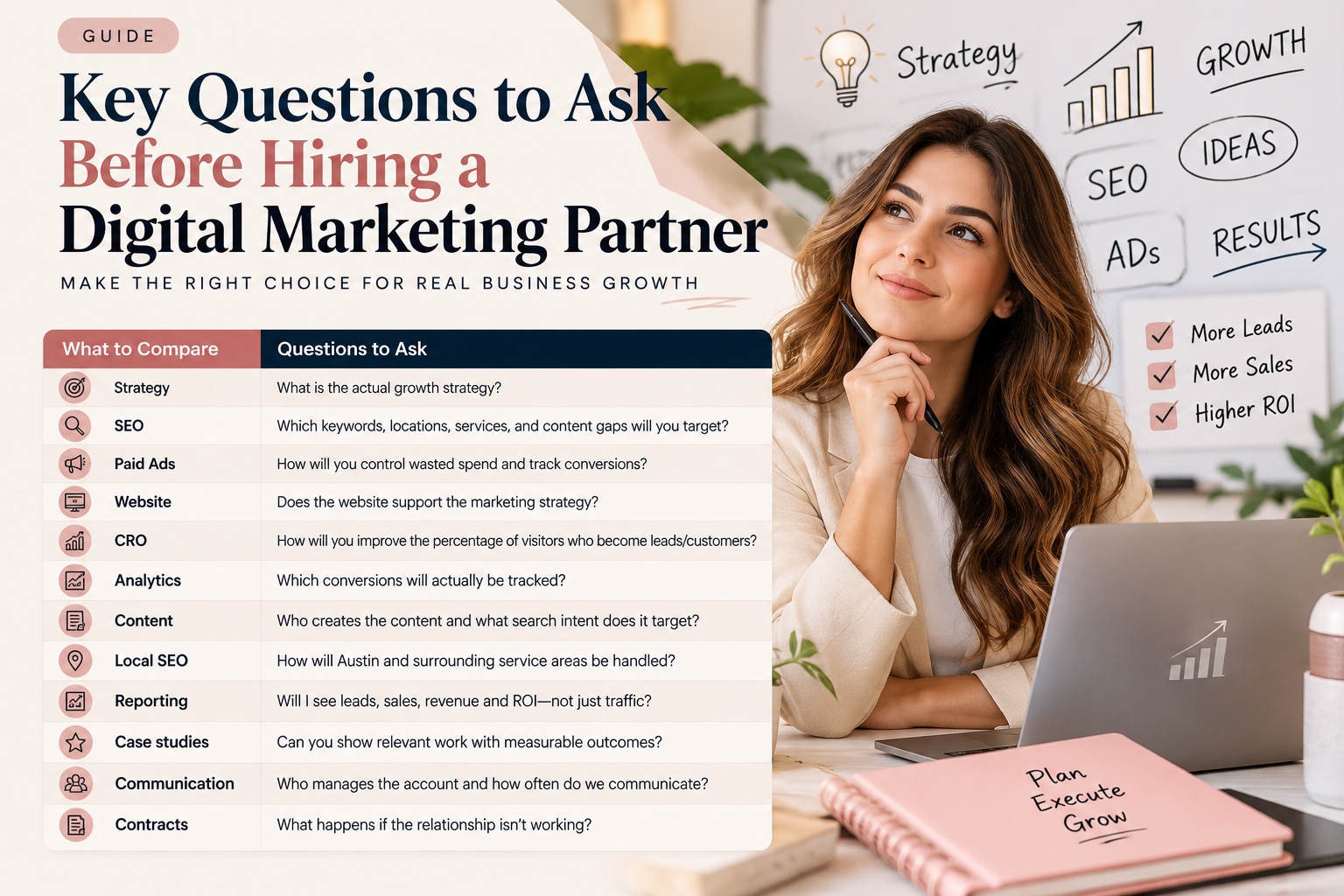
The point isn't to find an agency that says yes to everything.
It's to find an agency that can explain why something should or should not be done.
An Austin business should look for an SEO strategy based on search intent, technical health, service pages, local relevance, content architecture, internal linking, authority, and measurable conversions rather than simply publishing generic blogs. The agency should also explain how SEO supports the business's actual customer acquisition process.
For example, a local service company shouldn't necessarily try to rank one homepage for every possible keyword.
A stronger structure could be:
Homepage
→ Core service pages
→ Austin location page
→ Suburb/location pages where genuinely relevant
→ Supporting informational content
→ Case studies
→ Conversion pages
That structure gives Google and AI systems more specific information to understand.
Austin marketing content specifically discusses building suburb-specific architecture for areas such as Cedar Park, Round Rock, Georgetown, Pflugerville, Kyle, and Buda instead of relying on one generic Austin page.
This is important because “Austin” isn't always the entire market.
Your customers may live outside the city itself.
Your service area may be broader.
Your keyword strategy should reflect that reality.
Explore AheadTech360's Austin marketing approach
A digital marketing company in Austin should be able to identify when SEO, paid advertising, web development, social media, email, or CRO is the appropriate solution instead of automatically selling the same service package to every business. The right channel depends on the business model, customer journey, competition, budget, and desired outcome.
SEO is useful for building long-term organic visibility around searches your customers are already making.
It can include:
Technical SEO
Keyword research
Local SEO
On-page optimization
Content strategy
Internal linking
Link building
Location pages
Search intent mapping
AI search optimization
See AheadTech360's SEO content and strategy resources
Google Ads can put a business in front of people who are already searching for a product or service.
But an agency shouldn't stop at:
Keyword → Ad → Click
The real system is:
Keyword → Ad → Landing Page → Conversion → Tracking → Optimization
AheadTech360's paid-search guidance emphasizes the importance of matching targeting, ad messaging, landing pages, and conversion tracking rather than treating campaign launch as the end of the work.
Read AheadTech360's Google Ads guide for small businesses
Your website is where much of your marketing traffic eventually lands.
If the website is slow, confusing, poorly structured, difficult to use on mobile, or unclear about what the business offers, more traffic won't automatically solve the problem.
AheadTech360 works across Shopify, WordPress, and custom development, with published examples involving ecommerce builds, custom functionality, mobile-first development, and CRO.
See AheadTech360's web development and marketing services
Conversion rate optimization focuses on what happens after someone arrives.
That can involve:
Better landing pages
Clearer messaging
Better CTAs
Shorter forms
Better mobile UX
Trust signals
Checkout improvements
User behavior analysis
This is often the missing link between traffic and revenue.
You can evaluate an agency's experience by looking for specific case studies that explain the original problem, the work performed, the measurable result, and the time period involved rather than relying on vague claims such as “we grew traffic.” A relevant case study should help you understand how the agency thinks, not just show you a screenshot.
AheadTech360's Results page currently documents work across 75+ brands, with published figures including $1.56M+ revenue generated, 7.05x best ROAS, and $6.48 lowest CPL. Individual examples include ecommerce, lead generation, paid advertising, CRO, and web development.
View AheadTech360's Results and case studies
The EZDTFMaker case study documents revenue growth from $35K to $163K over 13 months, alongside 363% revenue growth, 405% order growth, and a 7.70x best ROAS.
The work wasn't limited to one marketing channel. It combined Meta Ads, Google Ads, CRO, and email automation.
That's an important distinction.
If the business problem involves the entire customer journey, solving one channel in isolation may not be enough.
The Ez Print Pros project included a 10+ page Shopify store, a six-step custom builder, three product lines, mobile-first development, custom pricing logic, product pages, and checkout functionality.
That is a different type of challenge from simply designing a five-page brochure website.
The TrashedPunk case study documents 18 creatives, six creative angles, 40+ ad variations, and five pages wireframed as part of a launch system built from zero.
Again, the website wasn't treated separately from marketing.
That's the kind of connection you should look for when reviewing an agency
Using one agency for SEO, PPC, web design, and CRO can simplify coordination when those channels need to work together, while specialized providers can make sense when a business has strong internal marketing resources or highly specialized requirements. The important issue is whether the responsibilities are clearly defined and the channels work toward the same business goal.
Imagine your Google Ads team discovers that the landing page converts poorly.
If the advertising agency doesn't control the website, the fix may take weeks.
If the SEO team finds that your service architecture is weak, the website team may need to rebuild important pages.
If analytics isn't configured correctly, neither team may know whether the changes worked.
This is why integrated marketing can be useful.
One strategy.
One measurement framework.
One customer journey.
Different channels working together.
Marketing reporting should show the relationship between activity and business outcomes, including qualified leads, sales, revenue, conversion rates, cost per acquisition, and return on advertising spend where applicable. Traffic, impressions, rankings, and clicks can be useful diagnostic metrics, but they should not be treated as the final business result.
Ask an agency:
How many leads did we generate?
Then:
How many were qualified?
Then:
How many became customers?
Then:
How much revenue did those customers generate?
For ecommerce:
How much revenue did marketing generate?
For paid advertising:
What was the actual acquisition cost and ROAS?
For SEO:
Did organic visibility produce qualified business opportunities?
This is also why attribution matters.
AheadTech360's published Effing Gear case study, for example, documents a 37% attribution gap and a 2.99x true ROAS after identifying revenue that Meta was not reporting correctly.
A report that only says:
“Traffic increased 38%”
doesn't tell a business owner enough.
You need to understand what happened after the traffic arrived.
The cost of digital marketing in Austin depends on the services involved, competition, advertising budget, website requirements, content volume, technical complexity, and the amount of ongoing management required. A small local business with one service may need a very different engagement from an ecommerce company operating across multiple markets.
For example, your budget may need to account for:
SEO
Google Ads management
Ad spend
Meta Ads management
Website development
Landing pages
Content
Local SEO
Email automation
Analytics
CRO
That's why comparing agencies by a single monthly number can be misleading.
Two agencies can both quote:
$2,000/month
while delivering completely different levels of work.
Instead, compare:
What am I getting?
Who is doing the work?
How often is it optimized?
What is included?
What does the reporting show?
What happens when something isn't working?
AheadTech360's own website-cost guidance makes the same broader point for web projects: apparently similar quotes can represent very different scopes and levels of customization.
The timeline depends on the marketing channel, starting position, competition, budget, website quality, and execution, with paid campaigns capable of producing data quickly while SEO generally needs longer to build organic visibility and authority. An agency should explain the expected timeline for each channel instead of promising one universal result date.
For SEO, the first stage may involve:
Technical foundation → Keyword architecture → Content → Internal linking → Authority → Ranking growth
For paid ads:
Tracking → Campaign structure → Testing → Optimization → Scaling
For CRO:
Research → Hypothesis → Page changes → Testing → Measurement → Iteration
If an agency promises guaranteed first-page rankings or guaranteed revenue within a fixed short period, ask exactly what assumptions support that promise.
Good marketing has variables.
The agency should be transparent about them.
An Austin marketing agency can prepare content for AI search by making important business information explicit, answering real customer questions directly, building strong topical coverage, maintaining consistent business information, and connecting claims to relevant supporting pages. The objective is not to write content for a chatbot alone; it is to create information that is useful enough for search engines and AI systems to understand and reference.
For example, an Austin business should have clear information about:
Who it serves
What it sells
Where it operates
Which services it provides
How its process works
What results it has achieved
Who is behind the company
What customers commonly ask
Which problems it solves
This creates stronger information architecture for both traditional search and AI-driven discovery.
It also means your blog shouldn't be 1,500 words of keyword repetition.
Instead, it should answer the questions your potential customer actually has.
That's why this article includes direct answer sections, practical comparison criteria, case studies, FAQs, service relationships, and first-hand business insights.
The biggest warning signs include vague promises, guaranteed rankings, unclear deliverables, vanity-metric reporting, generic strategies, long contracts without clear accountability, lack of relevant case studies, and agencies that cannot explain how their work connects to revenue or qualified leads. Another warning sign is an agency that recommends the same service package regardless of the business model.
Be careful when an agency says:
“We'll get you tons of traffic.”
Ask:
“What kind of traffic?”
When they say:
“We'll improve your rankings.”
Ask:
“For which commercial keywords?”
When they say:
“We'll run Google Ads.”
Ask:
“What conversion events will you track?”
When they say:
“We'll redesign your website.”
Ask:
“What conversion problem are we trying to solve?”
Those questions quickly separate strategy from sales language.
Before hiring an agency, ask about its process, relevant experience, reporting, team structure, contract terms, communication, tracking, expected timelines, and what happens when a strategy does not produce the expected result. You should also ask the agency to explain its recommended channels in plain language.
Here are 10 questions worth asking:
What would you change about my marketing first?
Which channel do you think should receive the most attention, and why?
What would you measure every month?
How do you track qualified leads?
Can you show me a relevant case study?
Who actually works on my account?
How often do you optimize campaigns and content?
What happens if the strategy isn't working?
What exactly is included in the monthly fee?
Can I leave if the relationship isn't working?
Don't be afraid of an agency that tells you “not yet.”
Sometimes the right recommendation is to fix the website before spending more on ads.
Sometimes it's to fix tracking.
Sometimes it's to build the SEO foundation first.
Sometimes paid search makes more sense.
The right recommendation depends on the business.
AheadTech360 works with businesses that want SEO, paid advertising, web development, CRO, email, and related marketing activities connected to measurable business outcomes rather than managed as isolated tasks. Its published Results page documents work across ecommerce, lead generation, advertising, CRO, and development, while its Austin content outlines a local-market approach covering SEO, Google Ads, Meta Ads, web design, and email marketing.
See AheadTech360's Austin marketing strategy
The approach starts with a simple question:
What's actually stopping the business from growing?
If the problem is SEO, fix SEO.
If it's paid advertising, fix the campaigns.
If it's the website, fix the conversion experience.
If it's tracking, fix attribution.
If it's the entire funnel, connect the pieces.
That is a more useful starting point than deciding in advance that every business needs the same marketing package.
What should you do before choosing an online marketing agency in Austin?
Before choosing an online marketing agency in Austin, define your business goal, identify the channels that currently generate customers, understand where the funnel is breaking, and compare agencies based on relevant experience, measurable results, strategy, and accountability. The right agency should be able to explain what it would prioritize and why.
Use this final checklist:
Clear business goal
Defined target customer
Clear offer
Identified acquisition channels
Conversion goals
Keyword research
Search intent mapping
Technical SEO
Local SEO
Content strategy
Internal linking
AI/AEO/GEO considerations
Conversion tracking
Campaign structure
Negative keywords
Landing-page strategy
Budget allocation
Ongoing optimization
Clear messaging
Mobile UX
Fast pages
Strong CTAs
Trust signals
Analytics
Conversion tracking
Relevant case studies
Clear deliverables
Transparent reporting
Defined communication process
No unexplained long-term commitment
Clear ownership/access to your accounts Ready to find what's actually holding your marketing back?
You don't need another generic marketing proposal.
You need to know:
What's working?
What's wasting money?
Where are potential customers dropping out?
What should you fix first?
AheadTech360 starts engagements with a free audit designed to identify the problems and give you actionable information before you decide what to do next. The company's Results page also documents its work across SEO, paid advertising, CRO, ecommerce, web development, and lead generation.