We helped 75+ brands generate $1.56M+ in revenue. Average ROI: 240% in Year 1
Traditional advertising has always worked on a very simple — and slightly terrifying — premise: you pay upfront, run your ad, and hope for the best.
You pay $2,000 for a magazine spread and you have no idea how many people saw it, let alone how many of them called you. You buy a radio slot and cross your fingers. You put up a billboard and wait.
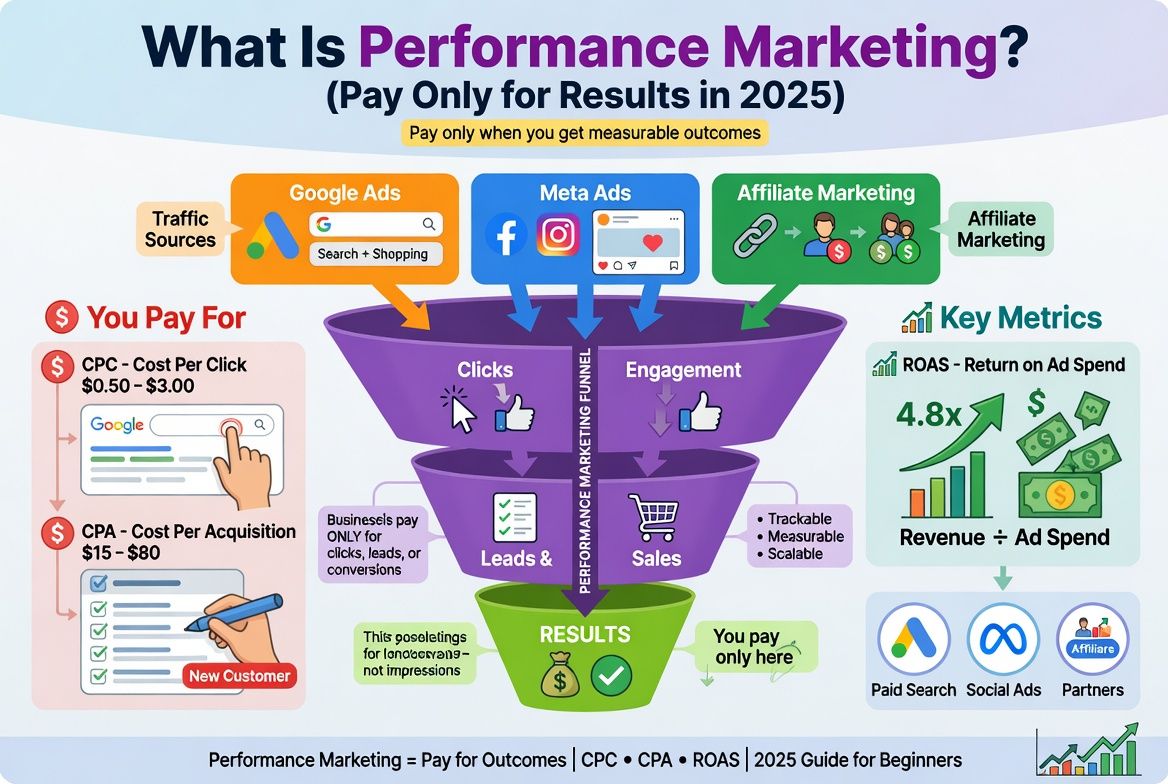
Performance marketing flips that model on its head. Instead of paying for exposure, you pay for outcomes — a click, a lead, a sale, a phone call. If nobody takes action, you pay nothing or dramatically less. The risk shifts from you to the results.
That sounds obvious in 2025 — but most small businesses are still not taking full advantage of it. This guide explains exactly what performance marketing is, how it works, which channels it covers, and how to evaluate whether it makes sense for your business.
At AheadTech360, performance marketing is the foundation of how we approach paid advertising for every client. We don't believe in 'brand awareness campaigns' for businesses that need leads. We believe in campaigns where every dollar spent is traceable to a specific business outcome — a call, a form submission, a sale. That is performance marketing.
Performance marketing is digital advertising where you pay based on specific actions — not just for showing an ad. The 'performance' refers to measurable outcomes: a click, a form submission, a phone call, a purchase, or an app install.
The key difference from traditional advertising:
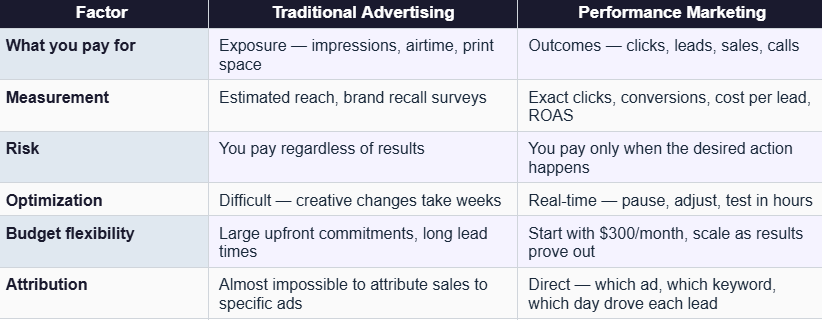
Performance marketing is not a single channel. It is a category of advertising defined by its accountability model — and it covers several different platforms and tactics.
The 5 Main Performance Marketing Channels
Paid Search (Google Ads / Bing Ads)
You bid on keywords and pay only when someone clicks your ad. The person searching is already looking for what you offer — making paid search the highest-intent traffic available in digital marketing. Ideal for service businesses, local businesses, and anyone whose customers search Google when they need help. Average CPC across industries: $1–$6 for local services, $15–$50 for legal and financial.
Paid Social (Meta Ads, LinkedIn Ads, TikTok Ads)
You run ads on social platforms and pay per click or per conversion. Unlike paid search, you are interrupting people who are not actively searching — so your ad needs to create the desire rather than respond to it. Best for visually engaging products, brand building with a defined demographic, and businesses with broad appeal. Average CPC: $0.50–$2.50 for Meta, $5–$15 for LinkedIn.
Affiliate Marketing
You partner with publishers, bloggers, or influencers who promote your product and earn a commission for every sale or lead they generate. You only pay when a conversion happens. Zero upfront cost — but requires a strong offer, a competitive commission, and finding the right affiliate partners. Very popular in ecommerce, financial services, and SaaS.
Display and Programmatic Advertising
Banner ads, native ads, and video ads placed across millions of websites and apps through automated bidding systems. Can be bought on a CPM (per 1,000 impressions), CPC (per click), or CPA (per conversion) basis. Most effective for retargeting — showing ads to people who have already visited your website. Lower intent than search, but very cost-effective for staying top of mind.
Shopping Ads and Product Listing Ads
Product-specific ads on Google Shopping and other platforms that show your product image, price, and name directly in search results. Exclusively relevant for ecommerce businesses. Pay per click. Driven by your product feed rather than keywords — Google decides which searches your product appears for based on your product data.
Performance marketing is only meaningful if you track the right numbers. These are the metrics every small business running performance campaigns should understand:
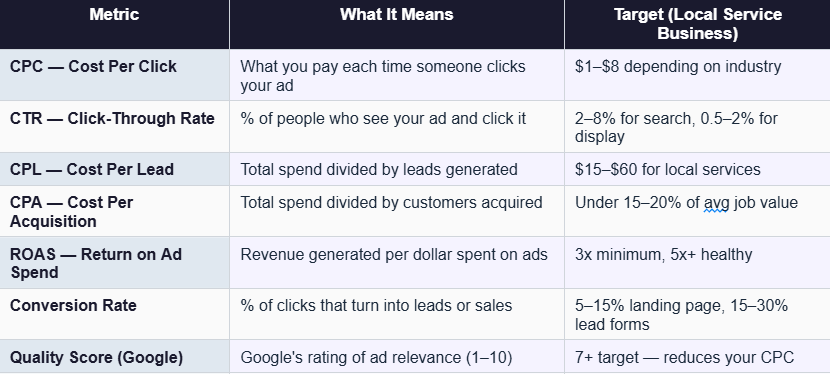
The most dangerous performance marketing mistake small businesses make: optimizing for the cheapest metric instead of the most important one. Getting a $0.40 click means nothing if those clicks never convert. A $12 click that generates a $400 customer is dramatically better than a $0.40 click that generates nothing. Always evaluate campaigns on cost per lead and cost per acquired customer — not just cost per click.
Performance marketing works best when you have three things in place:
A measurable conversion goal — A specific action you want visitors to take: fill out a form, call a number, book an appointment, make a purchase. Without a clear conversion goal, you cannot measure performance.
A realistic customer acquisition budget — Performance marketing is not free — you pay per action. For most local service businesses, a minimum viable budget is $300–$500/month in ad spend to generate enough data to optimize campaigns. Below this, you get too few clicks to make meaningful decisions.
A landing page or website that converts — Even the best-targeted ad generates zero leads if it sends people to a slow, generic, or confusing website. Your landing page needs to match your ad's promise, load fast on mobile, and make the desired action obvious.
Large brands spend millions on TV, radio, and billboards because they can afford to. Small businesses cannot — and should not. Performance marketing levels the playing field by letting a $400/month small business compete with a $40,000/month national brand on specific local keywords — and win, because the small business can be more relevant, more specific, and more targeted to exactly the customer they want.
Performance marketing is not a complicated concept — it is simply the principle that you should know what your advertising money is buying. Every click, every lead, every customer should be traceable to a specific campaign, a specific ad, a specific keyword.
For small businesses with limited budgets, this accountability is not optional — it is essential. You cannot afford to run campaigns you cannot measure. Performance marketing gives you the data to know what is working, scale what is profitable, and cut what is not — and that is exactly the kind of control a small business needs when every dollar counts.
Traditional advertising asks you to spend and hope. Performance marketing asks you to spend and measure. That difference is worth everything.